MACRO HERD BEHAVIOUR AND THE SIZE EFFECT: A COMPARATIVE ANALYSIS BETWEEN SHARIA (ISSI) AND NON-SHARIA STOCKS IN INDONESIA
Abstract
This study aims to identify and analyze the patterns of macro herding behavior in the Indonesian Stock Market (IHSG) and to compare the intensity of general herding and the influence of Market Capitalization (Size Effect) between the Sharia Stock Index (ISSI) and Non-ISSI sub-samples. Utilizing weekly stock price data from all IDX-listed companies for the 20112024 period, the study applies the more robust Tessler and Venezia Herding Model (2022). Comparative analysis is performed on the Total IHSG, ISSI, and Non-ISSI segments. It is found that macro herding is detected in the IHSG, predominantly during extreme market conditions. The intensity of general herding is found to differ significantly between the ISSI and Non-ISSI groups, and the influence of Market Capitalization on herding also exhibits distinct patterns across the two sub-samples.The originality lies in the application of the robust Tessler and Venezia Model (2022) in the Indonesian Market and the comparative analysis of herding and Size Effect in the dualistic ISSI/Non-ISSI market. The findings confirm that Sharia compliance and firm size are important determinants moderating collective investor behavior, providing strong practical implications for regulators (OJK) and market participants.
References
Ackert, L. F. , & D. R. (2010). Behavioral finance: Psychology, decision-making and markets.
Bookstaber, R. (2007). A Demon of Our Own Design: Markets, Hedge Funds, and the Perils of Financial Innovation. Wiley.
Chang, E. C., Cheng, J. W., Kong, H., & Khorana, A. (2000). An examination of herd behavior in equity markets: An international perspective.
Daxhammer, R. J., Facsar, M., & Papp, Z. A. (2023). Behavioral Finance: Limited Rationality in Financial Markets. UVK Verlag.
Mirakhor, Abbas., & Iqbal, Zamir. (2011). An introduction to Islamic finance: Theory and practice. John Wiley & Sons (Asia).
Padungsaksawasdi, C. (2020). Herd behavior and firm-specific information. Cogent Economics and Finance, 8(1). https://doi.org/10.1080/23322039.2020.1844399
Shefrin, H. (2005). A Behavioral Approach to Asset Pricing. Elsevier Academic Press.
Tessler, N., & Venezia, I. (2022). A multicountry measure of comovement and contagion in international markets: definition and applications.
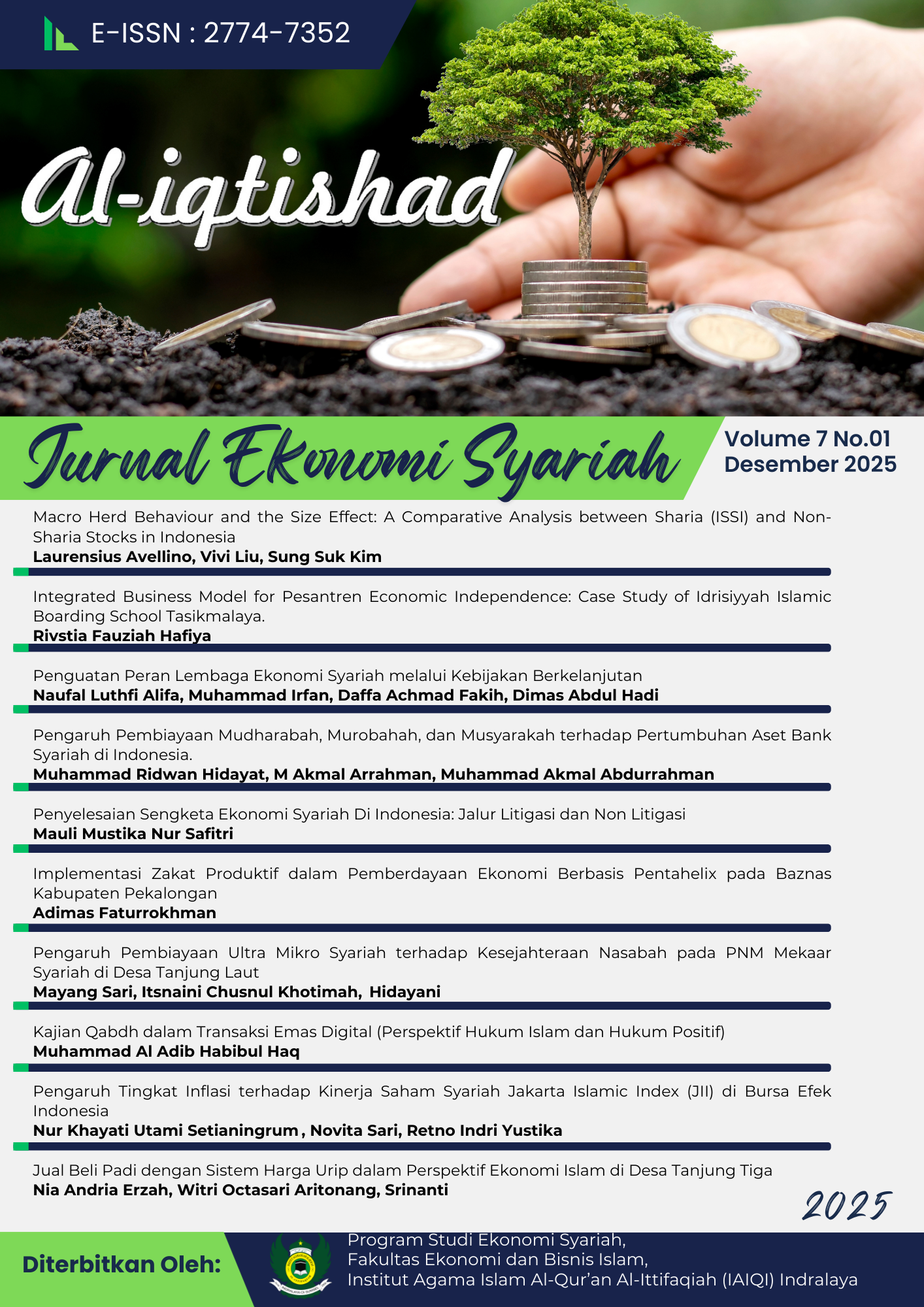
Copyright (c) 2025 Al-Iqtishad: Jurnal Ekonomi Syariah

This work is licensed under a Creative Commons Attribution-ShareAlike 4.0 International License.
LA RIBA: Jurnal Perbankan Syari’ah is licensed under a Creative Commons Attribution-ShareAlike 4.0 International License
Copyright Notice
An author who publishes in LA RIBA: Jurnal Perbankan Syari’ah agrees to the following terms:
- The author retains the copyright and grants the journal the right of first publication of the work simultaneously licensed under the Creative Commons Attribution-ShareAlike 4.0 License that allows others to share the work with an acknowledgement of the work's authorship and initial publication in this journal
- The author can enter into separate, additional contractual arrangements for the non-exclusive distribution of the journal's published version of the work (e.g., post it to an institutional repository or publish it in a book) with the acknowledgement of its initial publication in this journal.
- The author is permitted and encouraged to post his/her work online (e.g., in institutional repositories or on their website) before and during the submission process, as it can lead to productive exchanges, as well as earlier and greater citation of the published work (See The Effect of Open Access).
Read more about the Creative Commons Attribution-ShareAlike 4.0 Licence here: https://creativecommons.org/licenses/by-sa/4.0/.
Privacy Statement
The names and email addresses entered in this journal site will be used exclusively for the stated purposes of this journal and will not be made available for any other purpose or to any other party.